Swing treading
Introduction
Swing trading is a speculative treading Strategy in financial markets where a tradable asset is held for one or more days in an effort to profit from price changes or 'swings'. A swing trading position is typically held longer than a day trading position, but shorter than buy and hold investment strategies that can be held for months or years. Profits can be sought by either buying an asset or short selling Momentum signals (e.g., 52-week high/low) have been shown to be used by financial analysts in their buy and sell recommendations that can be applied in swing trading.Swing trading is a trading strategy that focuses on profiting off changing trends in price action over relatively short timeframes. Swing traders will try to capture upswings and downswings in stock prices. Positions are typically held for one to six days, although some may last as long as a few weeks if the trade remains profitable. Traders who swing trade stocks find trading opportunities using a variety of technical indicators to identify patterns, trend direction and potential short-term changes in trend.
Strategy of swing trading:
Five strategies for swing trading stocks
- Fibonacci retracements. The Fibonacci retracement pattern can be used to help traders identify support and resistance levels, and therefore possible reversal levels on stock charts. ...
- Support and resistance triggers. ...
- Channel trading. ...
- 10- and 20-day SMA. ...
- MACD crossover.
1. Fibonacci retracements
The Fibonacci retracement pattern can be used to help traders identify support and resistance levels, and therefore possible reversal levels on stock charts. Stocks often tend to retrace a certain percentage within a trend before reversing again, and plotting horizontal lines at the classic Fibonacci ratios of 23.6%, 38.2% and 61.8% on a stock chart can reveal potential reversal levels. Traders often look at the 50% level as well, even though it does not fit the Fibonacci pattern, because stocks tend to reverse after retracing half of the previous move.
2. Support and resistance triggers
Support and resistance lines represent the cornerstone of technical analysis and you can build a successful stock swing trading strategy around them.
A support level indicates a price level or area on the chart below the current market price where buying is strong enough to overcome selling pressure. As a result, a decline in price is halted and price turns back up again. A stock swing trader would look to enter a buy trade on the bounce off the support line, placing a stop loss below the support line.
3. Channel trading
This swing trading strategy requires that you identify a stock that's displaying a strong trend and is trading within a channel. If you have plotted a channel around a bearish trend on a stock chart, you would consider opening a sell position when the price bounces down off the top line of the channel. When using channels to swing-trade stocks it's important to trade with the trend, so in this example where the price is in a downtrend, you would only look for sell positions – unless price breaks out of the channel, moving higher and indicating a reversal and the beginning of an uptrend. Learn more about breakout stocks here.
4. 10- and 20-day SMA
Another of the most popular swing trading strategies involves the use of simple moving average (SMAs). SMAs smooth out price data by calculating a constantly updating average priceancial markets where a tradable asset is held for one or more days in an effort to profit from price changes or 'swings'. A swing trading position is typically held longer than a day trading position, but shorter than buy and hold investment strategies that can be held for months or years.
Profits can be sought by either buying an asset or short selling Momentum signals (e.g., 52-week high/low) have been shown to be used by financial analysts in their buy and sell recommendations that can be applied in swing trading.Swing trading is a trading strategy that focuses on profiting off changing trends in price action over relatively short timeframes. Swing traders will try to capture upswings and downswings in stock prices. Positions are typically held for one to six days, although some may last as long as a few weeks if the trade remains profitable. Traders who swing trade stocks find trading opportunities using a variety of technical indicators to identify patterns, trend direction and potential short-term changes in trend.
5. MACD crossover
The MACD crossover swing trading system provides a simple way to identify opportunities to swing-trade stocks. It's one of the most popular swing trading indicators used to determine trend direction and reversals. The MACD consists of two moving averages – the MACD line and signal line – and buy and sell signals are generated when these two lines cross. If the MACD line crosses above the signal line a bullish trend is indicated and you would consider entering a buy trade. If the MACD line crosses below the signal line a bearish trend is likely, suggesting a sell trade. A stock swing trader would then wait for the two lines to cross again, creating a signal for a trade in the opposite direction, before they exit text MACD.

Example of a stock swing trade
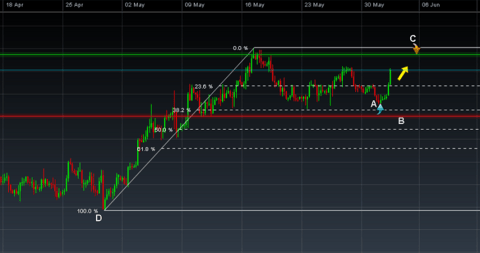
There are numerous strategies you can use to swing-trade stocks. In this example we've shown a swing trade based on trading signals produced using a Fibonacci retracement. The three most important points on the chart used in this example include the trade entry point (A), exit level (C) and stop loss (B). Any swing trading system should include these three key elements.
Guide to diagram:
A – Trade entry point
B – Stop loss
C – Price forecast (exit level)
D – Fibonacci technical analysis
The stop loss level and exit point don't have to remain at a set price level as they will be triggered when a certain technical set-up occurs, and this will depend on the type of swing trading strategy you are using. The estimated timeframe for this stock swing trade is approximately one week. It's important to be aware of the typical timeframe that swing trades unfold over so that you can effectively monitor your trades and maximise the potential for your trades to be profitable.
How to swing trade stocks
Now we have reviewed the most popular swing trading strategies, follow the below steps to open an account with us, so you can get started to swing trade stocks.
- Open a live trading account. Open a live trading account to start swing trading stocks. You can also open a demo account if you would like to practice the above swing trading strategies in a risk-free environment.
- Research markets using technical analysis. Utilising tools such as our pattern recognition scanner, you can spot trend reversals and other price signals to help inform your swing trading efforts.
- Choose an asset to swing trade. Once you have undertaken your research, decide which asset and time frame you wish to swing trade. Also, determine your entry and exit strategy based off your swing trading signal. For example, to buy AAPL when the price hits the support level.
- Use risk management conditions. Include a stop loss and take profit order to mitigate any risks. These risk management tools help keep your trades consistent and relevant to your trading strategy.
- Monitor your position. Keep an eye on your trade whilst it is open. Be aware of gapping and slippage, and changes within the market’s sentiment. Learn more about gap trading.
Which Stocks is best in weekly?
Weekly Stocks for Swing Trading
- Cipla Ltd (CIPLA) Cipla is involved in the business activities of Manufacture of pharmaceuticals, medicinal chemical and botanical products. ...
- Tata Elxsi Ltd (TATAELXSI) ...
- Aditya Birla Fashion (ABFRL) ...
- Sun Pharmaceuticals (SUNPHARMA) ...
- Forge (BHARATFORG)...
Swing Vs Day Trading: Which Is Better?
There is an ongoing debate regarding swing vs day trading.
As a trader, one’s first concern is to make maximum profit. So, between swing and day trading, which is profitable?
Both of the trading styles offer a wide range of advantages, but there are disadvantages, which you must note while choosing your style. The following list discusses the pros and cons of both.
- In terms of time, swing trade is spread across a longer time frame, hence demands less involvement. on the other hand, day trading needs constant monitoring of the market, and you have to be quick in decision making
- Swing traders look for a substantial profit, whereas day traders make maximum trades to optimize day’s profit.
- In terms of risk, swing traders assume more risk by leaving their position open overnight. Conversely, day traders close their position by day end. Hence, no risk gets carried forward.
- In swing trading, the trade takes more time to mature, and traders utilise the time to follow the market movement. It helps in lowering the risk. Day traders have to be quick to execute trades because one loss can wipe out the entire profit from the day
- Capital requirement is less for day trading than swing trading, which makes day trading accessible to most traders.
So, Why Is Swing Trade Better?
Swing trading is the best deal for beginner traders. It requires less skill and expertise. Additionally, if you are not a full-time trader, your next best option is swing trading, which doesn’t demand you to stay glued to the computer screen all day.
Thirdly, it is the only game for retail traders. Remember, when you are a trader, you are working alone, and there could be numerous market conditions working against you. Unless you have a sizeable corpus available and the ability to digest bigger risks, day trading can be difficult. In day trading, you have to react especially fast, and unless you have a great deal of experience and knowledge about the market, it can be difficult. On the contrary, swing trading allows you to judge the market and analyze trading opportunities before execution.


Comments
Post a Comment